
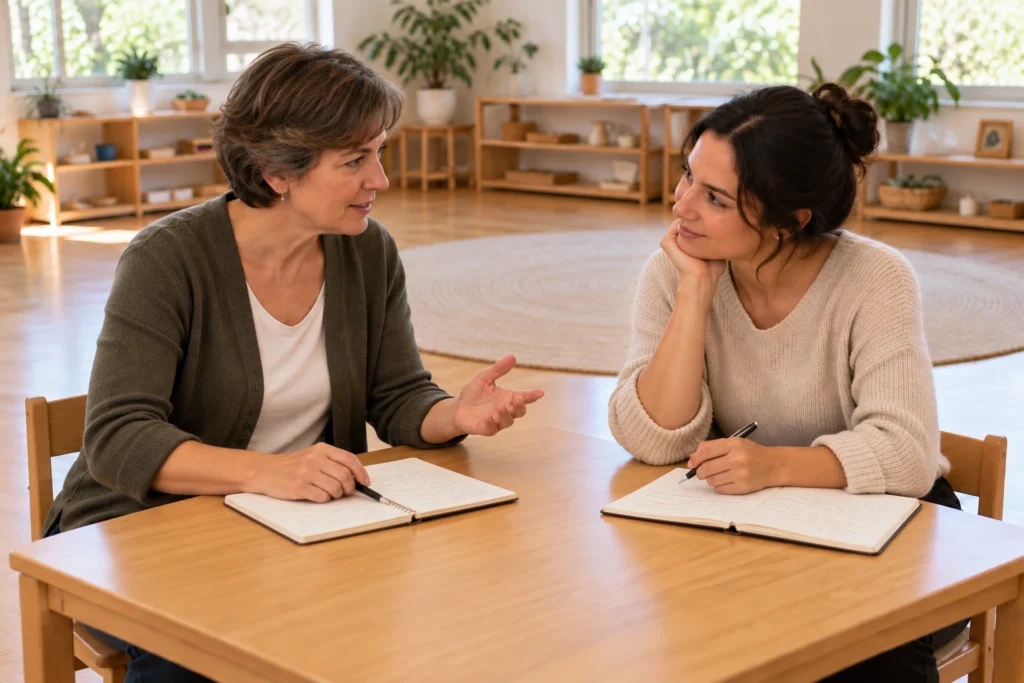
Supporting a Montessori classroom partnership throughout the first year
For Montessori school administrators, supporting a new assistant requires more than providing a list of duties. A new assistant arrives eager to help. The guide is giving a lesson, a child needs help with a spill, another is wandering, and a parent is waiting at the door. Within minutes, the assistant faces decisions that a job description cannot fully explain.
Should I step in? Should I wait? Can I redirect this child? Is answering this parent’s question part of my role?
What feels obvious to an experienced guide may be unfamiliar to someone entering the classroom. Even an experienced Montessori assistant needs to learn how this particular school and classroom team work together.
A thoughtful orientation matters. So does what happens afterwards. A new assistant needs a support and mentoring plan that extends throughout the first year, with regular opportunities to observe, practice, ask questions, and receive clear feedback.
Begin with the person’s experience
“New assistant” can mean several things. Someone may be new to working with children, experienced in another educational setting, familiar with Montessori but new to the school, or an experienced assistant joining a different guide.
These starting points call for different support.
Someone new to Montessori may need help understanding why we pause before offering assistance, protect concentration, or invite a child to participate in solving a problem. An experienced assistant may already understand those principles but need clarity about classroom routines, communication with families, and the guide’s expectations.
Before deciding what to teach, ask what the assistant already knows, what feels unfamiliar, and what they would like help understanding. Observation and conversation can then shape the plan.
Make the work visible
A list of duties can identify responsibilities. It rarely explains the judgment behind them.
“Support children’s independence” sounds clear until a child struggles with a coat while the rest of the class waits to go outside. “Help maintain the environment” leaves unanswered when to clean a table and when to leave a child time to notice and take responsibility.
The guide needs to demonstrate the work and explain the reasoning. That includes showing how to offer help, how to redirect respectfully, how to observe without interrupting, and how to respond when a child needs immediate support.
It also means discussing decisions explicitly: what the assistant can handle independently, what requires consultation, and what remains the guide’s responsibility.
As Brené Brown reminds us, “Clear is kind. Unclear is unkind.” Expecting someone to meet an expectation we have never explained places an unfair burden on them.
Clarity becomes useful when the assistant has opportunities to practice and revisit what they are learning.
Give conversations a place in the week
A classroom partnership cannot develop entirely through quick exchanges over children’s heads or a few words at dismissal.
During the early weeks, a brief daily check-in can help the guide and assistant clarify immediate questions. A protected weekly meeting allows them to look more closely at what is happening.
What went well? When was the assistant unsure whether to act? What did each adult notice about the children? Is there a routine that needs another demonstration? Have they given children conflicting messages?
These meetings can be short. They need to be dependable, scheduled within paid working time, and supported by whatever coverage is necessary.
Their purpose is shared understanding. The guide brings knowledge of the children’s plans and Montessori practice. The assistant brings observations and questions that may reveal something the guide has missed.
As the partnership becomes more confident, the frequency can change. Regular conversation should remain part of the work.
Make Honest Talk part of the relationship from the beginning
Elizabeth Slade’s Honest Talk approach offers a foundation for clear, caring conversations grounded in growth. It belongs in everyday support, including the small conversations through which adults learn to work together.
A reflective conversation might begin by asking what the assistant feels is working, then exploring a moment of uncertainty and choosing one manageable next step.
When a practice needs to change, the guide should be direct about what they observed, explain its impact, and agree on what to do differently. The conversation should include the support needed to make that change.
For example, a guide might say:
“During cleanup, I noticed that you put away several children’s work before they had a chance to finish. I’d like us to give them time to complete that responsibility themselves. Let’s look together at how we can prepare for the transition earlier.”
This gives the assistant something specific to understand and practice. It also gives the guide a responsibility: to demonstrate, support, and follow up.
The assistant needs room to speak honestly, too. “I’m receiving different instructions,” “I don’t understand why we do this,” or “I need more help with this transition” should be welcome information.
Honest Talk is drawn from Elizabeth G. Slade’s Montessori in Action: Building Resilient Montessori Schools and the work of Public Montessori in Action International.
How Montessori School Administrators Can Support New Assistants
The guide is central to the assistant’s development, but should have support in that work.
Montessori school administrators should ensure that a director of education, head of school, or designated mentor meets regularly with the new assistant throughout the first year. Early meetings might take place every two weeks, moving to monthly as the assistant settles in. The appropriate rhythm will depend on the person, the classroom, and the school’s capacity.
These conversations provide another place to ask questions, reflect on learning, and identify support needs. Classroom observations can help leadership offer specific coaching and understand how the partnership is developing.
Leadership should also check in with the guide. Does the guide have time to mentor? Are expectations consistent? Is help needed with demonstrating a practice or having a difficult conversation?
Schools should explain how mentoring conversations relate to evaluation and how concerns will be handled. Clear arrangements help adults participate with confidence.
Plan support across the whole first year
October brings different questions from August. Parent conferences, changing classroom dynamics, new children, and spring transitions introduce responsibilities that an initial orientation may barely touch.
A first-year plan should therefore name who provides support, when meetings happen, and how learning will be revisited.
In the opening weeks, the emphasis may be on observation, routines, safety, and role clarity. As the year progresses, coaching can address more complex situations and gradually expand responsibility where the assistant demonstrates readiness.
Midyear offers a useful point to review progress together. What has become comfortable? What still needs practice? What support has been missing?
At the end of the year, the conversation can look ahead: responsibilities for the following year, professional learning interests, and changes that would strengthen the partnership.
The plan can fit on one page. Its value comes from following through.
Confidence grows through supported practice
A new assistant should know whom to ask, what they are learning, and when they will have an opportunity to talk about it.
That confidence develops through clear expectations, demonstrations, honest conversation, and repeated opportunities to practice. It also depends on adults keeping their promises about support.
For school leaders, the question is straightforward: Does every new assistant have a first-year support plan, or does their experience depend on whichever classroom they happen to join?
A prepared environment for adults includes time and guidance for learning the work. When we provide those conditions, we give a new partnership room to become a strong one. Clever Education Solutions supports Montessori schools in building effective administrative practices and stronger classroom partnerships.