
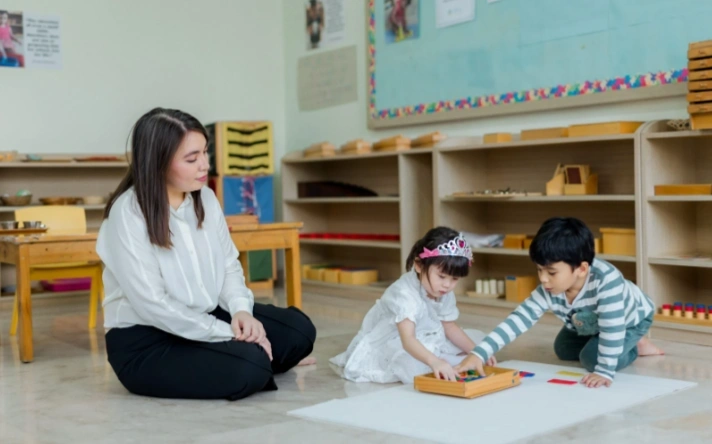
How mid-year observations and documentation shape family trust
January is a moment when families begin to take stock.
Not in obvious ways, and not always consciously, but through small, accumulated impressions. How clearly the school shares information and how well they understand each child. How steady the school feels when questions arise.
It is often during this time that families begin forming quiet conclusions about whether they feel confident continuing the journey ahead.
Mid-year parent-teacher conferences and reports play a powerful role in that process.
A Word About “Assessment”
Many educators describe this time of year as assessment season. It is a familiar term, and one that families may recognize.
In Montessori environments, however, what we do looks quite different.
Rather than evaluating or measuring a child against benchmarks, Montessori progress tracking is grounded in careful observation, thoughtful documentation, and narrative reflection. The purpose is not to judge progress, but to understand development, academically, socially, emotionally, and holistically.
When we use the word assessment here, we do so only as a bridge. What truly matters is the practice beneath it: observing with care, documenting with intention, and sharing insight in a way that honors the child.
Observation as Relationship Work
From a family’s perspective, mid-year documentation is not just informational. It is relational.
Families are listening closely to how the school speaks about their child. They notice whether the language feels specific and grounded, or generic and distant. They judge whether the school truly knows their child or merely describes them.
When observations are shared with care and clarity, families feel reassured, even when challenges are named honestly. When documentation feels disconnected or rushed, uncertainty can quietly enter the relationship.
This moment is not about perfection. It is about presence.
The Invisible Curriculum of Documentation
Every system teaches something.
The way observations are recorded, stored, and communicated becomes part of a school’s invisible curriculum. It communicates priorities long before policies are read or values are stated explicitly.
When documentation is coherent and accessible, families experience steadiness. When information feels scattered or opaque, they often feel the opposite, even if the classroom experience itself is strong.
What families learn in these moments is not only about their child’s development. They are learning how the school handles responsibility, communication, and care.
January as a Moment of Alignment
By January, families have enough lived experience to sense alignment or its absence.
They notice whether classroom observations and administrative communication reflect the same understanding. They feel whether the story being shared matches what they see unfold day to day.
Mid-year documentation lands within this broader context. When it aligns with lived experience, trust deepens. When it does not, families may begin to question not the child’s progress, but the school’s attentiveness.
January offers leaders a chance to bring these threads back together with intention.
Documentation That Supports Retention
Retention is rarely about a single moment. It is built through confidence over time.
Families are more likely to stay when they feel informed, respected, and included in an ongoing narrative about their child. Thoughtful documentation supports enrollment, re-enrollment, & retention by helping families understand the Montessori process, especially when growth unfolds gradually or in ways that do not resemble conventional schooling.
When schools take the time to contextualize development rather than summarize it, families are better able to trust the long view.
This is especially important in January, when decisions about the coming year begin to take shape quietly.
From Information to Partnership
At its best, documentation strengthens partnership.
Families are invited into a shared understanding of the child’s journey. This approach reassures them that the school is paying attention and reinforces that learning is not a checklist, but a process unfolding over time.
Here again, the invisible curriculum is at work, teaching families what it feels like to be in a relationship with the school, not just enrolled in it.
A Soft Invitation
As this mid-year moment arrives, it may be worth pausing to notice how observation and documentation are currently experienced by families.
Not only what is shared, but how it is shared. Not only the content, but the coherence.
Small refinements made now, bringing clarity, consistency, and care to this process, often have a lasting impact. When families feel genuinely seen and well-informed, trust grows quietly. And with trust, retention follows naturally.
A gentle closing thought
Mid-year documentation is more than a reflection of the child’s development. It is a reflection of the school’s attentiveness. When handled with intention, it becomes one of the quiet ways a school teaches steadiness, respect, and confidence—an approach supported by Clever Education Solutions.