
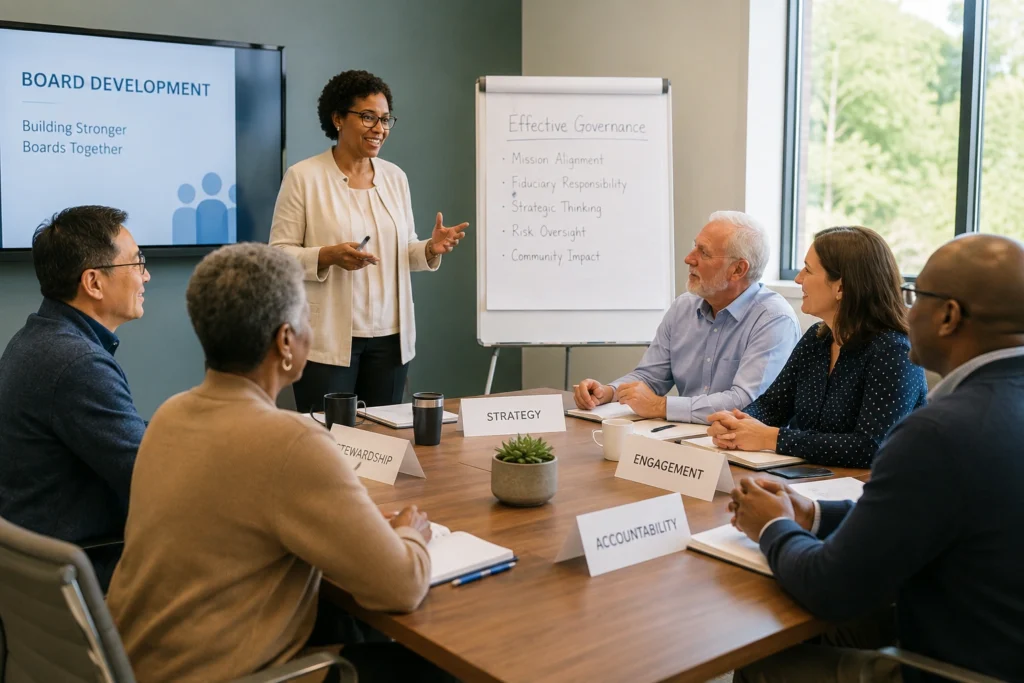
Too many well-meaning schools skip a critical step: training their board of directors. After all, board members are often passionate parents or community allies, volunteering their time to serve a cause they care about. They bring skills, energy, and good intentions. School administration solutions can help create the structure, clarity, and processes needed to support effective board governance and leadership.
But good intentions aren’t enough to run a school.
In Montessori environments, we believe in preparing the environment and giving children the tools they need to thrive. The same must be true for our boards. Without governance training, even the most committed board can become confused, disengaged—or worse, counterproductive.
1. Why Training Matters
Let’s be honest: the stakes are high. A board that doesn’t understand its responsibilities can:
- Overstep into day-to-day operations
- Fail to catch financial red flags
- Undermine the Head of School without realizing it
- Neglect its legal duties or compliance obligations
- Burnout from uncertainty and frustration
Training ensures that every board member understands:
- Their role and legal responsibilities
- The difference between governance and management
- How to provide financial oversight
- What it means to support and evaluate the Head of School
- How to engage in strategic planning and fundraising
2. What an Untrained Board Looks Like
We’ve seen it too often:
- A board member questioning a teacher’s performance directly
- Confusion over who’s responsible for hiring or setting tuition
- Meetings dominated by personal anecdotes or unclear priorities
- Financial reports were shared but not understood or discussed
These behaviors aren’t malicious—they’re the result of unclear expectations and a lack of preparation.
3. Governance Training Is a Sign of Respect
Training board members doesn’t insult their intelligence—it honors their commitment. It says:
“This role matters. We want you to be successful. Here’s how we do that together.“
Montessori school administrators play an important role in ensuring board members understand their responsibilities, maintain healthy boundaries, and contribute positively to the school’s mission.
Orientation should include:
- An overview of Montessori principles (for those new to the model)
- The structure and bylaws of the school
- The strategic plan and key performance indicators
- Annual fundraising goals and board giving expectations
- A clear description of roles, responsibilities, and boundaries
But it shouldn’t stop there. Governance development is ongoing.
4. How to Build a Culture of Learning
Try incorporating:
- Annual board retreats with external facilitators
- A “Governance Minute” at each board meeting for shared learning
- Required reading: books or articles on nonprofit leadership
- Paired mentorship for new board members
- A shared document library of resources (bylaws, budget, org chart, etc.)
Make it easy. Make it consistent. And make it clear that learning is part of leadership.
5. School Administration Solutions for Better Board Education
While the Head should not train the board alone, they can:
- Provide clarity on operations and the school’s strategic direction
- Offer feedback on how governance impacts day-to-day functioning
- Suggest topics where more board education is needed (e.g., school finance, Montessori philosophy)
- Participate in retreats or joint planning sessions
The Head’s role is not to manage the board—but to partner with them in mutual understanding and mission alignment.
Final Reflection
A board that understands its role, is committed to learning, and is aligned with the Head of School is a school’s greatest asset. It sets the tone for sustainability, trust, and growth.
Training isn’t optional. It’s foundational. It’s how we turn commitment into capacity.
So let’s equip our boards with the same intentionality we bring to our classrooms. Let’s prepare them not just to serve, but to lead.