
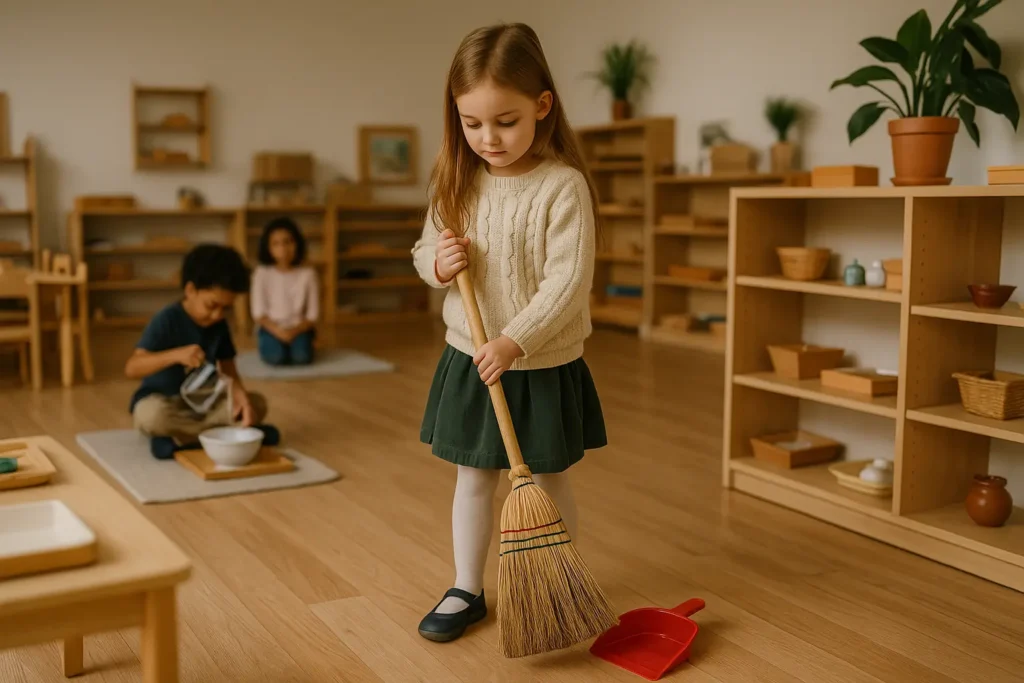
When we think about Montessori Practical Life activities, we often highlight the obvious benefits: children learn independence, responsibility, control of movement, and everyday life skills. But there is another, less visible gift embedded in these exercises — the ability to regulate emotions and find calm. This connection is crucial when considering Montessori ADHD support, and thoughtful Montessori solutions can help educators support these developmental needs.
Caroline Buzanko, PhD, recently wrote about the emotional dimension of ADHD in The Key to ADHD Emotional Regulation? Cultivating Gratitude, Pride & Compassion (June 2025). Her insights echo what Montessori educators have seen for over a century: children regulate not by thinking harder, but by engaging their whole selves — body, mind, and heart — in meaningful work.
The Emotional Brain vs. The Cognitive Brain
Dr. Buzanko explains that when emotions run high, children with ADHD cannot rely on the “cognitive brain” (executive functions like reasoning or problem-solving). Instead, the emotional brain takes control, often leading to impulsive reactions or intense outbursts.
Montessori children’s self-regulation strategies naturally address this reality. Montessori observed long before neuroscience gave us the language: reasoning with an upset child rarely works. What does work is inviting the child into movement — pouring water, sweeping the floor, scrubbing a table, polishing a mirror. Purposeful activity calms the body first, which allows the mind to re-center.
Practical Life as Emotional Regulation
Practical Life activities are deceptively simple, yet they weave together the physical and psychological in a way that creates natural self-regulation:
Self-Control through Movement
Carrying a tray without spilling or buttoning a frame requires careful, intentional motion. The child develops control over both hands and impulse, a key part of Montessori children’s self-regulation.
Calm through Integration
Physical action paired with a real purpose organizes the nervous system. The work itself soothes, much like a mindful practice, supporting Montessori Practical Life emotional regulation. A Montessori learning platform can complement these practical experiences by supporting activities that encourage focus, independence, and emotional regulation.
Order Restores Peace
Step-by-step sequences (wash, rinse, dry, put away) give children a framework of order that anchors them during times of inner chaos.
These are not just coordination exercises — they are experiences in emotional balance.
Gratitude, Pride, and Compassion in the Montessori Classroom
Dr. Buzanko highlights three prosocial emotions as essential for emotional regulation in ADHD: gratitude, pride, and compassion. Montessori environments cultivate all three in daily practice:
Gratitude emerges as children care for their classroom — watering plants, feeding fish, or polishing wood. They see themselves as stewards of their environment.
Pride blossoms when a child contributes meaningfully to the community — setting the snack table, preparing food, or cleaning up after lunch. Montessori educators know the power of “I did it myself!”
Compassion develops naturally as children help a younger classmate, share tools, or notice when someone needs a hand. Mixed-age classrooms provide daily opportunities for empathy and generosity.
These experiences mirror Dr. Buzanko’s strategies for building resilience in children with ADHD, reinforcing ADHD classroom strategies, and Montessori. Rather than suppressing negative emotions, Montessori fosters positive emotions that strengthen the child from within.
Why It Matters
Both research and Montessori practice tell us the same thing: self-regulation doesn’t start with lectures or logic. It begins with embodied, positive experiences that connect movement, meaning, and emotion.
When children pour, polish, sweep, and sew, they are doing much more than learning life skills. They are:
- Calming their nervous system
- Practicing self-control
- Building pride and confidence
- Strengthening empathy and gratitude
These are the very foundations of resilience — for children with ADHD, and for every child.
Closing Reflection
As Dr. Buzanko’s research affirms, when we nurture gratitude, pride, and compassion alongside purposeful movement, we give children the gift of self-regulation — a gift that lasts a lifetime. Montessori ADHD support through Practical Life activities enables children to develop the skills necessary for emotional and social well-being.
At Clever Education Solutions, we believe strong systems support not just administrators, but the entire Montessori community — educators, children, and families. Subscribe to our newsletter for more Montessori insights and resources.